Haunani
because every brain reads differently…
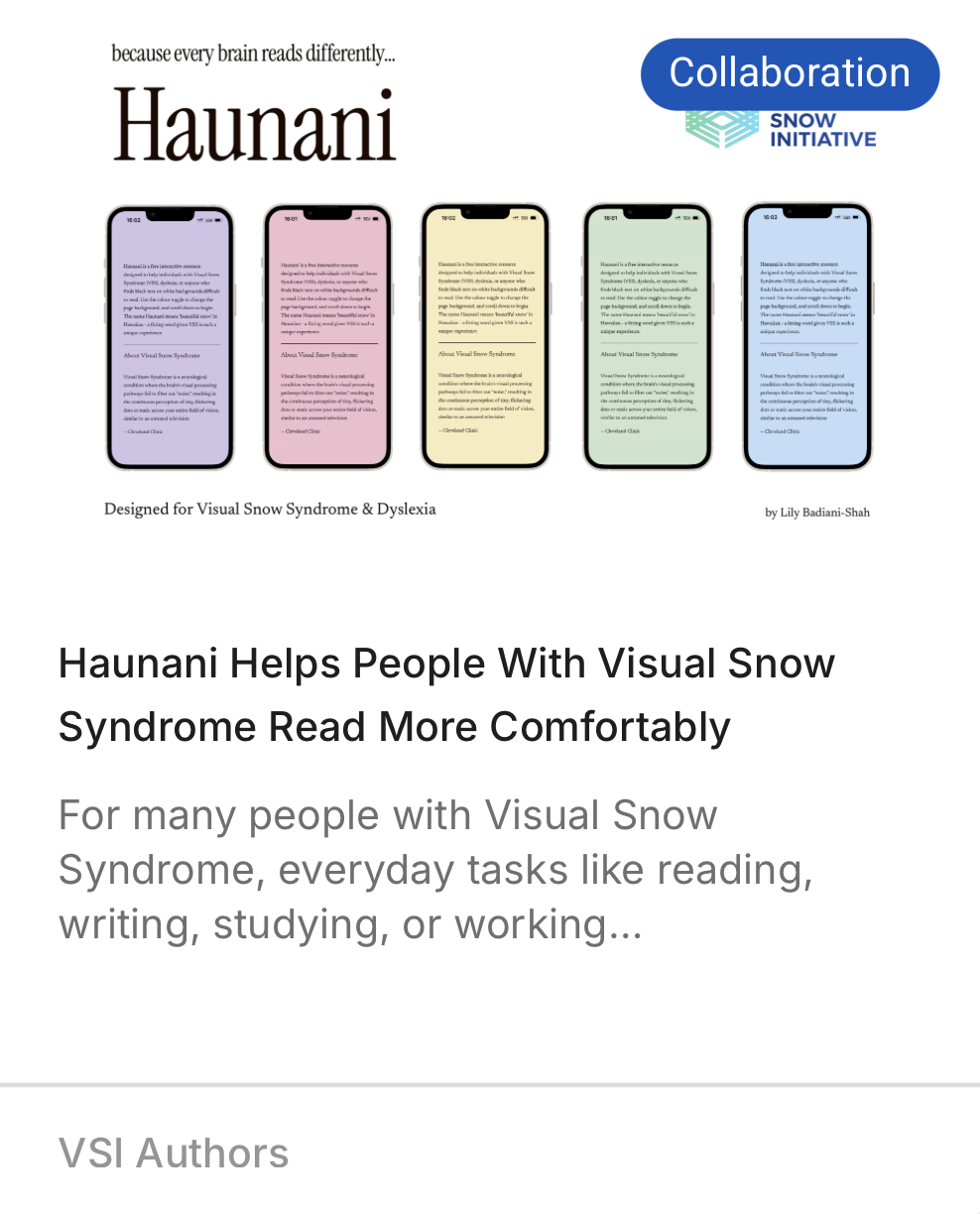
Designed for Visual Snow Syndrome & Dyslexia

In Collaboration With:
Haunani is a free interactive resource designed to help individuals with Visual Snow Syndrome (VSS), dyslexia, or anyone who finds black text on white backgrounds difficult to read. Use the colour toggle to change the page background, and scroll down to begin. The name Haunani means 'beautiful snow' in Hawaiian - a fitting word given VSS is such a unique experience.
About Visual Snow Syndrome
Visual Snow Syndrome is a neurological condition where the brain's visual processing pathways fail to filter out "noise," resulting in the continuous perception of tiny, flickering dots or static across your entire field of vision, similar to an untuned television
— Cleveland Clinic
Affects 2-3% of the World
Appears as a layer of static over your vision
Avg. of 9 years to diagnose
For more information visit: https://www.visualsnowinitiative.org/
My Story

My name is Lily. I was diagnosed with Visual Snow Syndrome at 15 years old, but I have been living with it my whole life. Before my diagnosis, I had always assumed I could see particles in the air. It wasn’t until I brought this up to family that I realized this wasn’t the norm. Getting a diagnosis wasn't a straightforward process. It took a GP, an ophthalmologist, and a neurologist to find the cause, along with an MRI, an EEG, and several other tests just to rule everything else out. For a condition that affects your vision every single day, the road to understanding it is surprisingly long.
I have always struggled to read and write due to the intense contrast glare, particularly with black text on white backgrounds. Every assignment requires me to read over the text at least twice to fully absorb it. I had been exploring different solutions on the market, mostly targeted at dyslexia, but none of them seemed to work. The only exception was printing on blue paper. I used this method frequently, especially during my exams (GCSEs and A Levels), but it proved to be somewhat impractical as I grew older.
Visual Snow can be quite an isolating experience, and so I wanted to create this community resource to help other individuals feel less alone and find what might or might not work for them, the way blue paper once worked for me.
The Project
What started as a university project (designing physical tinted lenses for people with VSS) eventually grew into this. I'm a product designer and recent graduate from Brown University and Central Saint Martins, and when I couldn't find a digital solution that worked for me, I decided to build one. This resource is free, anonymous, and open to anyone, whether you have VSS, dyslexia, or are just curious about how colour affects the way you read.
Find me on LinkedIn: https://www.linkedin.com/in/lilybadianishah/
As Seen on the Visual Snow Initiative
Click to Read more!

community resource
Made in collaboration with the Visual Snow Initiative
For the best experience complete on a computer. This is a short, simple interactive resource designed to help you identify which colours might work best for you when reading! This resource is available in 4 languages: English (UK) , French, Spanish and Chinese (Mandarin)
*No identifiable patient data stored (all anonymous), this resource is intended for users 18 and over
How does background colour affect your reading?
This short resource explores whether coloured backgrounds improve reading comfort and accuracy — particularly for people with Visual Snow Syndrome or dyslexia, though anyone is welcome to take part.
You'll be asked to rank colour preferences, read four short passages, and answer a few quick questions. The whole thing takes around 5–8 minutes.
Please note: This resource is not medical research and is not a diagnostic tool. We are not medical professionals. If you have concerns about your vision, reading, or any related symptoms, please speak to your healthcare provider.
By continuing, you agree that your anonymous responses may be used for research and product development. No personally identifiable information is collected or stored. Participation is entirely voluntary. This resource is intended for users aged 18 and over.
Select your language
Selecciona tu idioma
Sélectionnez votre langue
选择您的语言
Please note: This resource is not medical research and is not a diagnostic tool. We are not medical professionals. If you have concerns about your vision, reading, or any related symptoms, please speak to your healthcare provider. No personally identifiable information has been collected or stored.